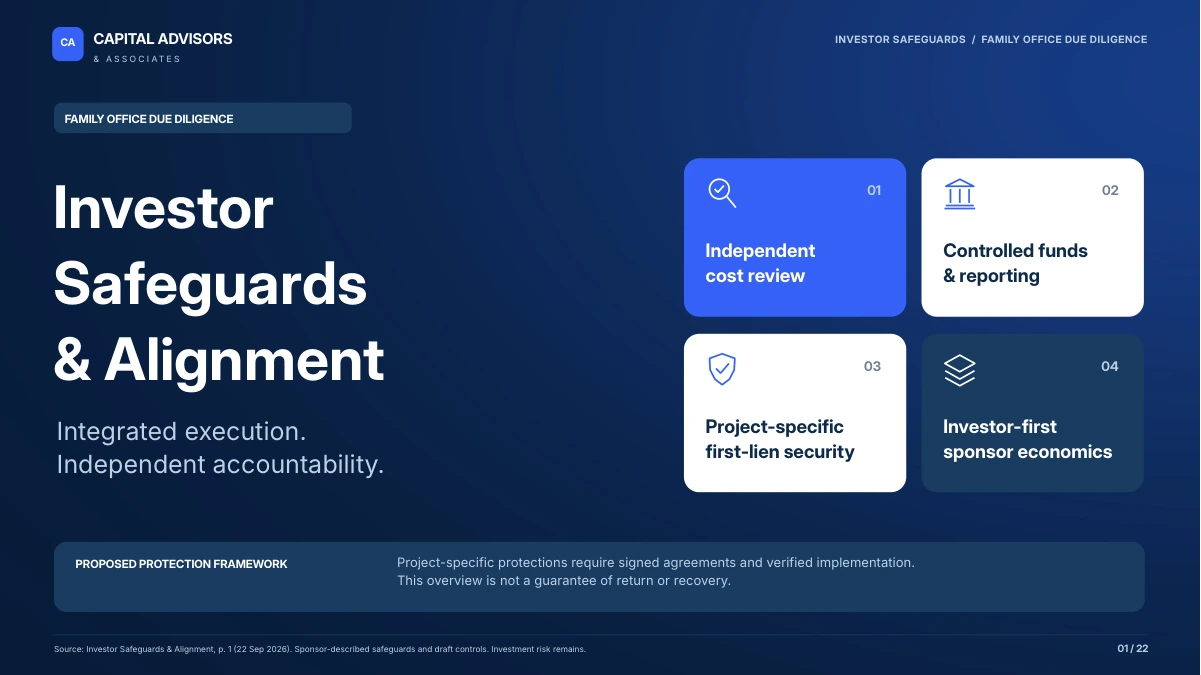
← Deal roomINVESTOR SAFEGUARDS & ALIGNMENT

FAMILY OFFICE DUE DILIGENCE

Integrated execution.
Independent
accountability.

Explore the proposed controls behind cost review, capital movement, project security and sponsor alignment.

ACCOUNTABILITY
BY DESIGN
01Independent
cost review
02Controlled funds
& reporting
03Project-specific
security
04Investor-first
economics

PROPOSED PROJECT-LEVEL FRAMEWORK

Proposed protection framework

Project-specific protections require signed agreements and verified implementation. This overview does not establish that all controls are in place and is not a guarantee of return or recovery.

01 / THE FRAMEWORK

Four safeguards.
One accountability framework.

Disclose conflicts, assign independent decision rights and document how each protection will operate for the selected transaction.

Management-described

Sponsor philosophy and per-project review.

Draft-documented

Controls identified in drafts; execution is not established.

Proposed commitment

Additional project-specific terms still to agree.

Status describes the supplied deck, not an independent verification of implementation. Source: deck, pages 1–3.

02 / INDEPENDENT COST REVIEW

Challenge the cost.
Document the decision.

The proposed charter makes independent review an approval requirement for contractors, engineering firms and related-party vendors.

DRAFT PRICING CONTROL

3written bids

For packages above $25,000.


Review affiliated arrangements of any size. Compare like-for-like scope, timing, insurance and warranty terms.

Exceptions require written approval from the independent reviewer and investor designee.
01

Independent reviewer

An unaffiliated contractor or cost consultant challenges scope, quantities, fees and remaining cost to complete.

02

Investor designee

Participates in approvals and approves the independent reviewer’s appointment, compensation and replacement.

03

Technical specialist

A separate qualified engineer or cost specialist reviews technical scope, staffing and fees when needed.

Both approvals. No self-vote.

Affiliated awards and fee increases require written reviewer and investor-designee approval, plus other required project consents. The recipient cannot vote on its own economics; the proposed charter does not permit a sponsor override of withheld sign-off.

Submit scopeDisclose feesIndependent reviewWritten approvalAuthorize & record

Open-book economics separate direct cost, overhead, fees, profit and markups. The deck calls for project benefit from rebates and credits, no undisclosed duplicate charges, and preserved payment-hold and recovery rights. Source: pages 4–6; draft D1 and proposed charter enhancements.

03 / FUNDS & PAYMENT CONTROLS

Separate the roles.
Control the release.

Follow the proposed path from a designated account to an investor-visible record. Select a stage to see the responsibility and required evidence.

01 / SAFEKEEP

Designated account

A named bank, custodian or escrow provider holds funds in a properly titled account under a written agreement. Project funds remain separate from sponsor operating cash and unrelated projects.

02 / VERIFY

Independent support

The administrator reviews records and prepares payments. A separate construction reviewer verifies work in place, approved scope and cost to complete. Accounting review does not replace technical verification.

03 / AUTHORIZE

Separate payment release

Follow a written authority matrix, separate preparation from release, prohibit self-release and apply an independent gate to affiliated payments. Use dual authorization and independently verify changed payment instructions.

04 / RECONCILE

Investor-visible record

Reconcile account activity, report approved and held draws, track affiliated compensation and prepare investor accounting. Pay vendors directly where practical.

Named in drafts ≠ appointment verified.

Moras drafts identify T-Capital through Yadira Treviño for administration. Provider identity, independence, authority and engagement still require verification. T-Capital / HQ Tax are not represented as qualified custodians; counsel must confirm the applicable custody arrangement.

Proposed control arrangement based on the deck’s description of drafts D2–D3. Source: pages 7–9.

REPORTING & ACCOUNTABILITY

A defined cadence.
A visible exception trail.

These proposed delivery targets belong in the signed administration agreement. They are not verified existing delivery commitments.

20calendar days

Monthly package

By the 20th calendar day after month-end: cash, reconciliations, budget, affiliated payments, draws and investor accounting.

30days

Quarterly review

Within 30 days after quarter-end: project progress, financial position and unresolved items.

2business days

Material-issue notice

Within two business days after awareness: a control failure, suspected misuse, significant cost gap or lien/default issue, with a remediation owner and timetable.

Administration

Tracks cash, reconciles records, calculates distributions and reports exceptions.

Independent audit

Requires a separate engagement and appropriate qualifications. No separate audit is represented as engaged or completed in this deck.

Proposed rights include direct reports, supporting records subject to confidentiality, an escalation route and an affected-draw hold. Final deadlines, recipients and enforcement rights require agreement. Source: deck, pages 10–12.

04 / PROJECT-SPECIFIC SECURITY

Security follows
the legal instrument.

For an eligible introductory transaction, the proposal pairs a senior-secured project note with a separately defined profit-participation feature.

SECURED NOTE

Specified collateral.
Documented priority.

Principal and contractual interest are secured only as stated in enforceable documents. Identify the actual lienholder, beneficiary, enforcement rights and any shared first-priority tranche.

PROFIT PARTICIPATION

Separately agreed
upside economics.

Residual participation follows the agreed waterfall. A separate equity or profit-participation feature is not automatically secured because the investor also holds a note.

01

Identify collateral

Name the borrower, property and complete legal description.

02

Execute documents

Sign the note, deed of trust and applicable assignments.

03

Confirm title priority

Obtain title confirmation of the intended first-priority position.

04

Resolve competing liens

Clear or subordinate claims as required for the closing.

05

Record and perfect

Complete required recording and perfection through counsel and title.

06

Match the legal holder

Identify the beneficiary, enforcement authority and any shared priority.

Fund equity alone does not provide a personal project lien.

The deck does not establish an executed property-specific first lien, collateral valuation or lending commitment. First lien describes priority, not guaranteed recovery; statutory claims, construction liens, title exceptions, falling values, completion costs and enforcement delays can affect recovery.

What must be defined before an advance?

The independently reviewed budget, cost to complete, reserves, collateral coverage, maximum advance rate and valuation basis. Also define completion funding, minimum lot-release prices, maturity, interest accrual, proceeds sweeps, defaults, cure periods and who can enforce remedies.

Terms are negotiated for selected collateral and do not apply automatically to every Fund investment. Counsel must review enforceability and applicable requirements. Source: deck, pages 13–16.

05 / PROPOSED ECONOMIC ALIGNMENT

Investor priority.
Then sponsor residual.

An illustrative introductory-program sequence. Signed agreements define interim distributions, reserves, residual sharing and any fee deferral.

01 / APPROVED COSTS

Required reserves

Actual, supported and approved labor, materials, taxes, insurance, permits, administration and other necessary operating costs may be paid during execution. Market-tested, contracted third-party service fees may also be paid as services are delivered.

02 / INVESTOR PRIORITY

Capital + contractual return

Under the introductory proposal, investor capital and the contractual priority return are paid before sponsor profit and agreed deferred compensation.

03 / INVESTOR UPSIDE

Agreed profit participation

The separately defined investor upside follows the residual waterfall agreed for the transaction.

04 / SPONSOR RESIDUAL

Permitted fees / profit

Under the proposal, sponsor distributions remain blocked while the required investor priority amount is unpaid. The administrator prepares a statement for disinterested approval before sponsor payment.

Deferral must be signed by each affected entity.

The proposed enhancement covers sponsor acquisition, development and management fees, affiliated contractor/engineering profit margins and sponsor distributions. Full affiliated-margin deferral is not represented as already in place. Necessary cost reimbursements remain separately identified, and any earlier fee or margin payment must be disclosed.

Existing Fund, note, construction and engineering agreements are not amended by this overview. Source: deck, pages 17–18.

06 / CONDITIONS BEFORE FUNDING

From proposed controls
to documented readiness.

Open each item to see the deck’s stated status and the evidence it calls for before funding. These are diligence items, not a certification of completion.

01Construction committee charterManagement-described / proposed

Status in the source

The enhanced committee charter is proposed.

Evidence to request

Named reviewer and investor designee; signed authority, independence disclosures and replacement rules.

02Budget & fee benchmarkingDraft-documented

Status in the source

Competitive-bid and no-self-approval controls are identified in draft D1.

Evidence to request

Comparable bids, independent review, approved budget, fee caps and change controls.

03Administration engagementDraft-documented

Status in the source

T-Capital duties and reporting are identified in draft D2.

Evidence to request

Executed engagement; verified entity, relationships, scope, insurance and deadlines.

04Cash safekeeping & releaseDraft-documented / provider unverified

Status in the source

Controlled-account procedures are described in D2–D3; the provider is not verified.

Evidence to request

Bank or custodian identity, proper account title, permissions, independent release authority and tested controls.

05First-lien securityProposed

Status in the source

The source packet establishes no property-specific perfected lien.

Evidence to request

Executed and recorded security, confirmed title priority and identified lienholder and beneficiary.

06Investor-first economicsProposed

Status in the source

Proposed for the selected introductory transaction.

Evidence to request

Signed waterfall, fee deferral, subordination, consent rights and consistency across documents.

07Reports & independent auditDraft report format / audit unverified

Status in the source

A monthly report format is identified in D2; no completed audit is verified.

Evidence to request

Sample reports, deadlines and an independent audit engagement where required or agreed.

08References & track recordSource examples / contacts incomplete

Status in the source

Two project-document examples are described; reference contacts are incomplete.

Evidence to request

Client permissions, named contacts, verified prior roles and reference calls.

THE FUNDING GATE

Executed documents.
Confirmed operating controls.

The proposal calls for the investor and counsel to receive executed documents and confirmation that controls are in place. Funds may remain in documented escrow pending closing.

Sponsor coordinatesCounsel confirms rightsReviewer validates costsAdministrator + bank confirm controlsInvestor approves conditions

“Draft identified” means described in the source packet, not signed, implemented or independently tested. Source: deck, pages 19–20.

Investor Safeguards and Alignment deck cover

THE ORIGINAL SOURCE / 22 PAGES

Review the framework
in full.

Read the complete Investor Safeguards & Alignment deck, including the draft-document basis, proposed controls and conditions before funding.

Updated deck supplied October 12, 2026 · Underlying safeguards packet dated September 22, 2026.

Document basis and limits of this overview

The deck cites D1–D3: Moras construction/development and administration agreements and organizational consent marked RAETZER DRAFT in September 2026. It also cites D4: Royal Oaks documentary history and D5: Lot 87 plans and a construction budget. Those references are carried forward from the supplied packet; the underlying files have not been newly verified for this page.

The deck’s public references concern private-fund fee conflicts and custody/audit terminology. This page does not certify regulatory applicability, adviser registration, legal compliance, property value or completed controls. Refer to page 21 and the definitive transaction documents.

REVIEW THE PROJECT-SPECIFIC DOCUMENTS

Let’s walk through
the safeguards together.

Discuss the selected investment, proposed control arrangements and the evidence needed before funding.