Maximum raise for all four phases
$8.875MHorizontal development + first 50 units
- $2,400,000 for horizontal development across the site
- $6,475,000 for the first 50 units at $129,500 each
The full $8,875,000 is counted once in the Fund I pipeline.
Condo-regime development / JV & equity
Primera, Texas
Our maximum total capital raise for all 200 condos is $8,875,000. It covers the site work and the first 50 units. As those units sell, we reinvest the proceeds to build the next 50, repeating the process through phase four.
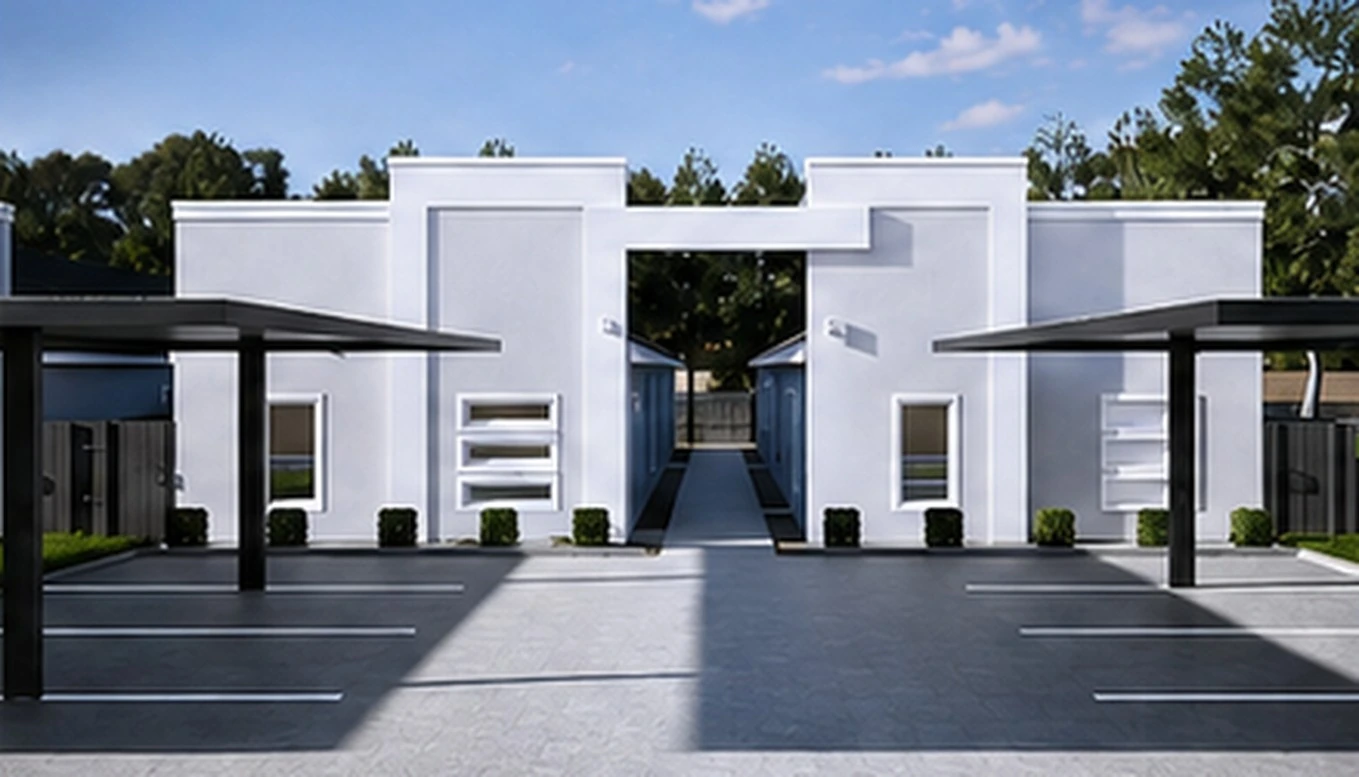 Illustrative rendering · Final design subject to change
The capital plan was updated November 21, 2026. The return and timing illustrations use the assumptions in the October 16 underwriting deck. Returns are project-level projections before financing, income taxes and JV allocations. Review the return assumptions.
01 / The opportunity
Hand Village is planned as a 200-unit condo-regime development in Primera, Texas. We budget $2,400,000 for horizontal work and $6,475,000 for the first 50 condos. Closed sales finance the following three 50-unit phases. The current fund pipeline values the 200 finished condos at $165,000 each.
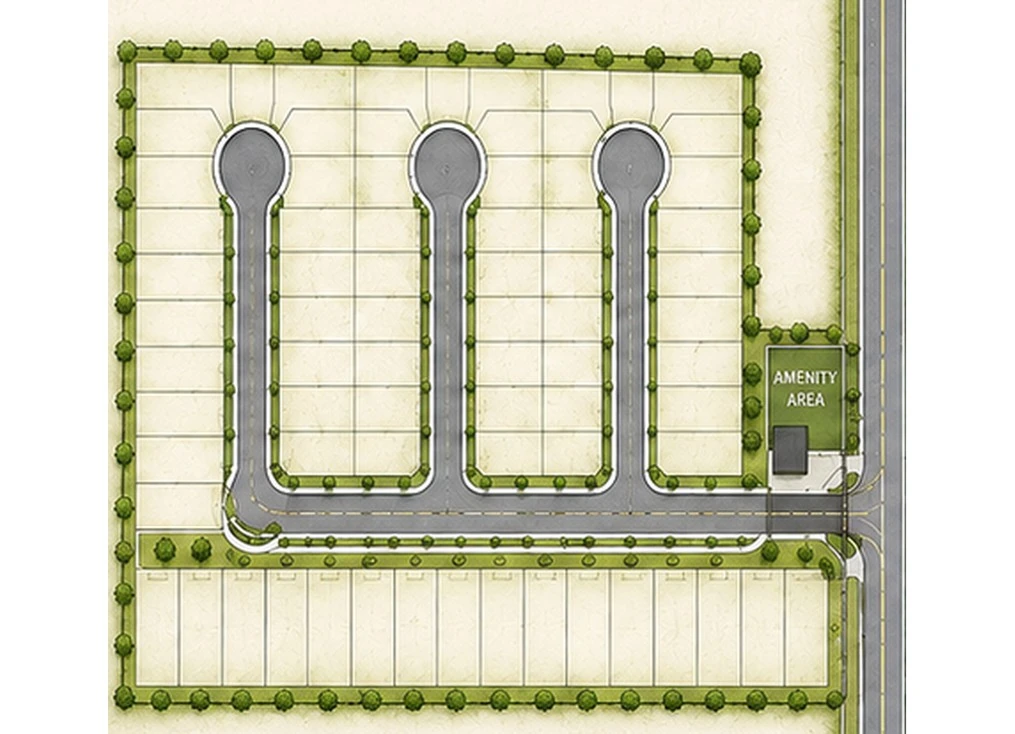
A closer look at the layout
The supplied artwork depicts an internal street network, turning areas and a designated amenity area.
The preliminary artwork labels 49 lots, which would equal 196 units at four units per lot. Final engineering and condo documents must reconcile the full 200-unit program, legal phasing, title and approvals. The rendering is illustrative; neither confirms a final design or completed construction.
See the plan in the deck ↗02 / The phased capital plan
One capital raise funds the start of development. Each later phase begins as closed sales generate the cash for the next 50 units.
Maximum raise for all four phases
$8.875MHorizontal development + first 50 units
The full $8,875,000 is counted once in the Fund I pipeline.
Each later phase / Recycled receipts
$6.475M50 units per phase
Each later phase draws on available sale proceeds. No additional equity raises are planned.
Horizontal: months 1–6. Build: months 7–15. Closings: months 16–18.
Build: months 16–24. Closings: months 25–27.
Build: months 25–33. Closings: months 34–36.
Build: months 34–42. Closings: months 43–48. Base-case distribution at month 48.
The schedule above comes from pages 3–4 of the October 16 deck. Each later construction start depends on closed sales and available cash.
October 16 deck illustration
The midpoint case assumes $185,000 per unit and $29.47M of total modeled costs, including 6% selling costs.
Before financing, income taxes and JV allocations. Additional 48-month carry is shown separately in the deck. The November capital plan caps the raise at $8,875,000 for the whole project. Budget inclusions, contingency and earlier land payments require confirmation.
03 / Modeled project returns
Updated underwriting / October 16, 2026
The base case contributes $8.875M at inception and returns $16.405M at month 48. That includes original capital and $7.53M of project profit: 84.8% cumulative ROI and approximately 16.6% annualized project equity IRR.
These are project-level projections, not promised net investor returns. Financing, taxes, fees and JV allocations can change investor outcomes.
One final $16.405M distribution at month 48; no interim distributions in the base case.
Optional case: $2.57M at months 18, 27 and 36, then $8.695M at month 48. Total proceeds remain $16.405M.
Project breakeven sale price under the stated development budget and 6% selling allowance, before additional costs.
Surplus distributions may include returned capital. The optional case retains the next phase’s unit budget; contingency, carry, lender restrictions and the JV waterfall could reduce or defer payments.
The base case holds development costs constant. Adding $120,000 of illustrative extra-year carry reduces profit to $7.41M, cumulative ROI to 83.5%, and annualized IRR to 16.4%. This allowance is not a bid.
Source: updated underwriting, pages 2 and 5–8. The historical $175,000 / two-phase / 36-month model is retained in the PDF appendix; its capital and returns do not apply to this updated scenario. No returns are guaranteed.
04 / Model assumptions & participation
$8,875,000 funds site work and the first 50 condos. Proceeds from unit sales fund phases two through four.
84.8% cumulative ROI / 1.85× equity multiple. The base case models 16.6% annualized project equity IRR, before financing, income taxes and JV allocations.
48 months / four phases of 50 units. Construction and closing delays can push back later phases.
Base case: all proceeds at month 48. The optional surplus-distribution scenario is illustrative and subject to reserves, restrictions and definitive terms.
JV / equity participation. Ownership, fees, distribution waterfall and recycling authority follow definitive project documents; this model does not establish investor allocations.
Minimum investment, final funding commitments and fee treatment require confirmation. Calculator examples do not establish a subscription minimum or accepted allocation.
Return illustrations use pages 1–8 of the October 16, 2026 deck. The current funding plan is dated November 21, 2026. Historical $175,000 underwriting remains in pages 9–37 for reference.
05 / 48-month project illustration
Scales the project-level equity multiple to an example amount. One initial contribution and one final payment; no investor waterfall or interim distributions are modeled.
Enter an amount greater than $0 and no more than $100,000,000.
ILLUSTRATIVE CAPITAL + PROJECT PROFIT
$184,845Final proceeds at month 48 under the selected assumption
Updated case: original capital × ($16.405M ÷ $8.875M). Lower-price cases use $14.525M and $12.880M of final project cash on the same $8.875M starting equity. Source: deck page 6. These are project illustrations before financing, income taxes and JV allocations, not net investor payouts. Actual dated cash flows determine IRR. No returns or payments are guaranteed.
06 / Updated phased 200-unit underwriting
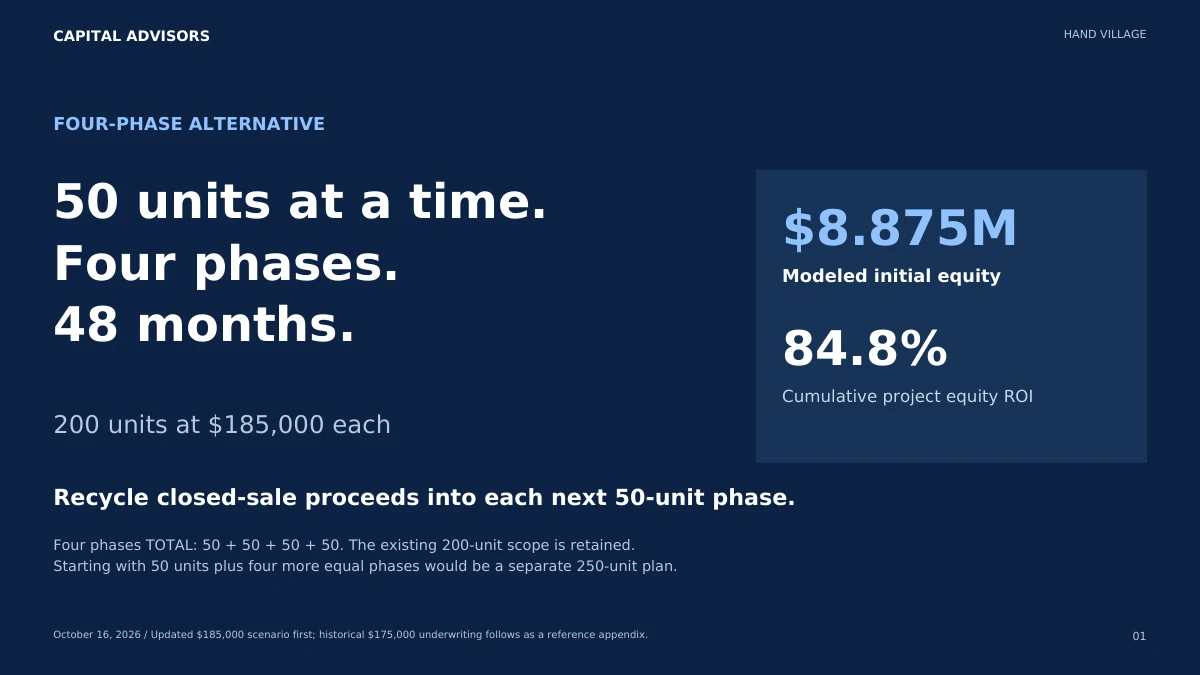
The supplied 37-page deck leads with the $185,000 sale-price scenario: four 50-unit phases, $8.875M initial equity, capital recycling, distribution timing, breakeven and sensitivity analysis.
37 pages · Updated October 16, 2026. October $185,000 / 48-month scenario: pages 1–8. Historical $175,000 underwriting: pages 9–37.
Review the timing of capital recycling, cash available above remaining costs, and the final distribution waterfall. Project cash cannot fund construction and investor distributions at the same time.
Request the diligence packageEXPRESS YOUR INTEREST
Request the documents, clarify the terms and review how this opportunity fits your objectives.
Schedule a private reviewPrepare an email to our team with the opportunity you’re reviewing.